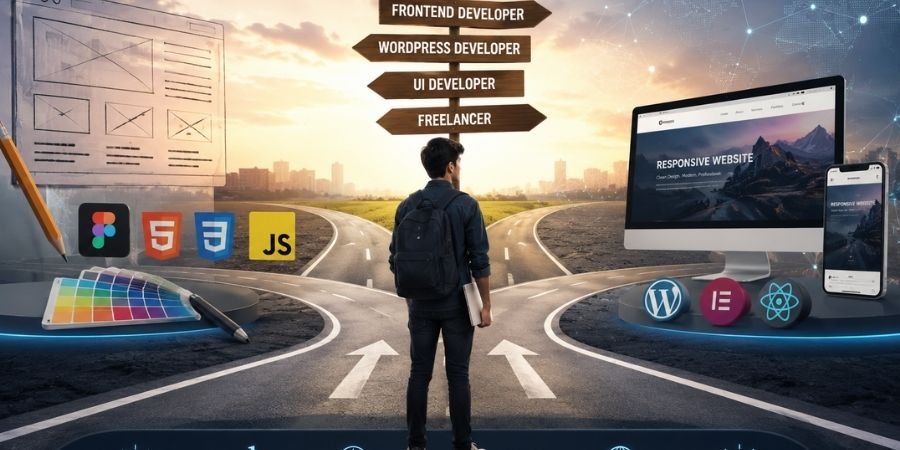
Completing 12th can be an important turning point for students who are deciding what to study and which career path to choose. If you are interested in technology, creativity, websites and digital work, web designing after 12th in Ballia can be an interesting career option to explore.
Web designing combines creativity with technology. You can learn how websites are planned, designed and developed using tools and technologies such as Figma, HTML, CSS, JavaScript, WordPress and React.js.
The good thing is that students do not necessarily need a computer science background to start learning web design. With structured training and regular practice, beginners can gradually develop the skills required to create professional websites.
What Is Web Designing?
Web designing is the process of planning and creating the visual appearance and user experience of a website.
It includes elements such as:
- Website layouts
- Colors and typography
- Navigation
- Images and graphics
- Buttons and forms
- Mobile-friendly layouts
- User interface design
- User experience
Modern web design can also involve frontend development, where the design is converted into a functional website using coding technologies.
For example, a designer may first create a website interface in Figma, while a frontend developer can use HTML, CSS and JavaScript to turn that design into a working website.
Can You Learn Web Designing After 12th?
Yes. Students can start learning web designing after completing 12th.
You do not need to already be an expert in coding. Beginners can start with basic concepts and gradually move toward more advanced website development skills.
A typical learning journey can look like:
Design Fundamentals → Figma → HTML → CSS → Responsive Design → JavaScript → WordPress → React → Projects → Portfolio
The important thing is to choose a learning path that combines both theory and practical work.
Skills You Should Learn After 12th
If you are planning to build a career in web designing, learning individual tools is not enough. You should understand how these tools work together to create complete websites.
1. UI and Website Design
UI (User Interface) design focuses on how a website looks and how users interact with its interface.
You can learn:
- Layout design
- Typography
- Color fundamentals
- Visual hierarchy
- Buttons and navigation
- Website structure
- Basic UX principles
These fundamentals help you create websites that are both attractive and easier to use.
2. Figma
Figma is a design and prototyping tool used to create website interfaces before development.
With Figma, beginners can practice creating:
- Website wireframes
- Landing pages
- Website layouts
- UI components
- Prototypes
- Responsive design concepts
Learning Figma can help you understand the design process before writing code.
3. HTML and CSS
HTML (HyperText Markup Language) provides the basic structure of a webpage. It is used for elements such as headings, paragraphs, images, links, forms and sections.
CSS (Cascading Style Sheets) controls the appearance of those HTML elements. It is used for colors, spacing, typography, layouts, animations and responsive designs.
Together, HTML and CSS form the foundation of frontend web development.
4. Responsive Web Design
Responsive web design means creating websites that adjust properly to different screen sizes.
A responsive website should provide a good experience on:
- Desktop computers
- Laptops
- Tablets
- Smartphones
This is an essential skill because people access websites from many different devices.
5. JavaScript
JavaScript is a programming language commonly used to add interaction and functionality to websites.
For example, JavaScript can be used for:
- Interactive menus
- Form validation
- Sliders
- Buttons
- Dynamic content
- User interactions
Beginners can start with variables, conditions, loops, functions, arrays, objects, events and DOM fundamentals.
6. WordPress and Elementor
WordPress is a content management system (CMS) used to create and manage websites without developing every feature completely from scratch.
Elementor is a visual page-building tool that allows users to design WordPress pages using a visual interface.
Learning WordPress can be useful for students interested in creating business websites, blogs, portfolios, landing pages and websites for clients.
What Career Options Are Available After Learning Web Designing?
Learning web design can open several possible career directions. Your opportunities will depend on your skills, portfolio, experience and specialization.
Web Designer
A web designer focuses primarily on website layouts, visual design, user interfaces and the overall appearance of websites.
Frontend Developer
A frontend developer builds the part of a website that users see and interact with.
Frontend development commonly involves technologies such as HTML, CSS and JavaScript, with modern libraries or frameworks such as React.
WordPress Developer
A WordPress developer creates, customizes and maintains websites using WordPress.
This can include working with themes, plugins, page builders and website layouts.
UI Developer
A UI developer combines interface design concepts with frontend technologies to create functional and visually consistent user interfaces.
Freelance Web Designer
A freelance web designer works independently with clients instead of working exclusively for one organization.
Freelancers may create websites for:
- Small businesses
- Local shops
- Startups
- Professionals
- Bloggers
- Agencies
However, freelancing requires more than technical knowledge. Communication, project management, pricing and client handling are also important.
Why Projects Matter After 12th
One of the biggest mistakes beginners make is focusing only on completing a course or collecting certificates.
A project demonstrates that you can actually apply what you have learned.
For example, you can create:
- Business websites
- Landing pages
- Portfolio websites
- Responsive websites
- WordPress websites
- JavaScript projects
- Figma UI designs
- React interfaces
Working on projects helps you understand how individual skills come together to create a complete website.
Build a Portfolio
A portfolio is a collection of your best work that demonstrates your practical abilities to potential employers or clients.
Instead of simply saying that you know HTML, CSS or WordPress, a portfolio can show actual websites and designs you have created.
A beginner portfolio could include:
- Personal portfolio website
- Business website
- Responsive landing page
- WordPress website
- Figma UI project
- JavaScript project
- React frontend project
As you gain experience, you can replace basic practice projects with stronger real-world work.
Choosing a Web Designing Course in Ballia After 12th
If you are looking for a Web Designing Course in Ballia, don’t select an institute only because of its advertisements or certificate.
Look for a program that provides:
- Beginner-friendly teaching
- Practical assignments
- HTML and CSS fundamentals
- JavaScript training
- Responsive web design
- Figma and UI design
- WordPress and Elementor
- Modern frontend development
- Real projects
- Portfolio development
- Career guidance
A structured Web Designing Training in Ballia can help students follow a planned learning path instead of trying to learn unrelated technologies randomly.
For students who want to explore both design and development, a program covering website design, frontend development and practical projects can provide a broader foundation.
Why Learn Web Designing in Ballia?
Students do not always need to move to a major city immediately to begin developing digital skills.
A local learning environment can provide access to structured training, practical assignments and guidance while students continue building their technical foundation.
For students searching for Web Design Classes in Ballia, the important factor should be the quality of learning rather than simply the location.
Creatofly Academy’s 12-month Web Designing & Frontend Development Career Program combines design fundamentals, Figma, HTML, CSS, JavaScript, responsive design, WordPress, Elementor, React.js, Git & GitHub and AI tools with practical projects and portfolio development.
You can learn more about the Web Designing Course in Ballia offered by Creatofly Academy through the main program page.
A Simple Career Path After 12th
If you are completely new to web designing, you can follow a gradual learning path:
Step 1: Learn website and UI design fundamentals.
Step 2: Practice Figma and create website layouts.
Step 3: Learn HTML and CSS.
Step 4: Build responsive websites.
Step 5: Learn JavaScript fundamentals.
Step 6: Explore WordPress and Elementor.
Step 7: Learn frontend development with React.
Step 8: Build multiple practical projects.
Step 9: Create a professional portfolio.
Step 10: Prepare for internships, employment, freelancing or further learning.
This approach allows you to build skills progressively rather than trying to learn everything at once.
Final Thoughts
Web designing after 12th in Ballia can be a practical option for students who enjoy creativity, technology and building websites.
You can start with design fundamentals and gradually learn Figma, HTML, CSS, JavaScript, responsive web design, WordPress and React.js. The most important part is to practice regularly and build projects that demonstrate your abilities.
If you are considering a Web Development Course in Ballia or a Website Designing Course in Ballia, compare the curriculum, practical training, projects, portfolio development and career guidance before making your decision.
Remember that completing a course does not guarantee a job. Your career growth will depend on the skills you develop, the quality of your portfolio, practical experience, communication abilities and the opportunities you pursue.
For students ready to start learning, the right combination is simple:
Learn → Practice → Build → Create a Portfolio → Prepare → Grow